《对早期苏美文明万神殿的一种可能解释》
苏美尔吧
全部回复
仅看楼主
level 15
酷酷游戏 楼主
《ONE POSSIBLE INTERPRETATION OF THE STRUCTURE OF THE EARLY SUMERIAN PANTHEONON》
作者:Peeter Espak,塔尔图大学(University of Tartu)研究人员
文中涉及Abu Salabikh神表、法拉神表(所谓的《法雷神册》)、马里神表等。文章不长,可以直接看结论。
恩里勒与恩基“竞争”,这套说法是:无鸡之谈(没料你说个J……)。因为没有任何追溯性可言。(看图)
Several conflicting opinions of Enlil and Enki in – for example in the Flood Stories – seem to be mythological motives of an ancient “action story” and they seem not to represent any rivalry between different theological schools.
洪水故事(另有阿卡德语版《阿特拉哈西斯》)中,恩里勒与恩基的做法纯粹是为了完成故事的动机,并非表达什么竞争。
注:文中这段话中,“action story”,本人不是很理解,自然,本人从未说自己水平够。
但在《法拉神表》(SF 23版),与Abu Salabikh神表(OIP 99版?),有别于其他神表排列,的确存在一组en-ki序位在恩里勒之前的内容。(这里的en-ki与nin-ki,也有学者异议,指是其他神,并非是我们所知晓的那个恩基)
本人心心念念的《马里(马瑞)神表》其中一处内容……
有意思的是,文中指出引了王献华先生的文章内容。
2019年06月17日 16点06分 1
level 15
酷酷游戏 楼主
好了,就匪夷所思的地方,探讨一下。
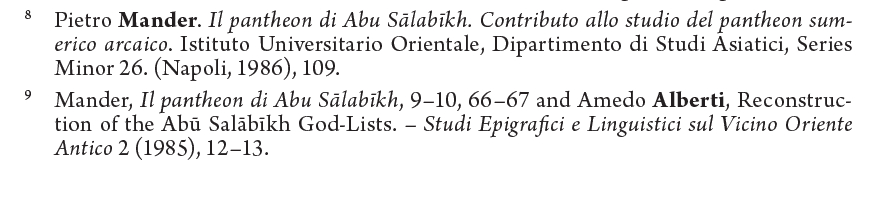
虽然,文中Abu Salabikh神表(OIP 99版?)明确提到引援自两位学者Pietro Mander与Alberti Almedo的文章。
enenuru论坛上,同样是引自Alberti Almedo给出的《Abu Salabikh神表》内容。
The Abū Salābīkh god-list (edition from 'A Reconstruction of the Abū Salābīkh God-List' by Amedeo Alberti, SEL 2, 1985)
可以看到,enenuru论坛上,Alberti Almedo的《Abu Salabikh神表》,en-ki序位并没有在nin-KID之前。
因此,本文提到的《Abu Salabikh神表》不知是存在不同异版,又或是Pietro Mander修补的内容。
2019年06月17日 17点06分 2
level 14
Alberti Almedo的重构
其他书里面引用的Pietro Mander的
但是这应该指的不是同一块泥板,两者内容差异很大,且Pietro Mander的那块里的神都是男女成对出现的。
2019年06月18日 04点06分 3
也既是说,的确是不同版本的
2019年06月18日 11点06分
level 14
Here is some information about a goddess i was unaware of so far named Lisi, who seems to have been the patron deity of Abu Salābīkh.
from:
The Name Nintinugga with a Note on the Possible Identification of Tell Abu Salābīkh
Author: Mark E. Cohen
Source: Journal of Cuneiform Studies, Vol. 28, No. 2 (Apr., 1976)
We suggest that the zà-mì hymns edited by R. Biggs OIP99 hold the key to
revealing the ancient name of modern Tell Abu Salābīkh.
Noting that no other fragments of this work have appeared in either Fara or Adab,
we see no reason not to conclude that this work wasn´t native to Abu Salābīkh.
And if this be the case, then according to an analysis of the zà-mì hymns,
Lisi was the goddess of Abu Salābīkh. We base this statement upon three observations:
1) The ordering of the compilation of the zà-mì hymns:
The only other Sumerian work of a structure similar to that of the zà-mì
hymns is the Temple Hymns, edited by A. W. Sjoberg, TCS3. Tradition,
attributed the compilation and the ordering of the hymns to Enḫeduanna,
the daughter of Sargon of Akkad. The Temple Hymns conclude with a
doxology to Nisaba, the goddess of the scribal arts, in a fashion similar to
the previously discussed closing doxologies to Nisaba during the Fara
period. Actually the concluding temple hymn is to the é-a-ga-dè.ki, the
temple of A(m)ba in Akkad, the city of the redactor, Enḫeduanna. This
final position of this temple hymn thus appears to be a place of honor.
Similarly we suggest that the positioning of Lisi at the conclusion of the zà-mì
hymns to be no accident, but rather a deliberate honor bestowed upon
the goddess of Abu Salābīkh.
2) The form of the individual zà-mì hymns:
Each individual zà-mì hymn concludes with the formula DN zà-mì
"DN, praise!" However the conclusion to the zà-mì hymn to Lisi is unique:
dingir-gal-gal ama dLi8-si4zà-mì
"The great gods (and) mother Lisi, praise"
The fact that Lisi alone is deserving of being singled out from the collective
body of the great gods is obvious evidence of the special position of Lisi in
this composition.
3) The epithet "mother Lisi":
In the zà-mì hymns only three goddesses have the prestigious epithet
ama, "mother," Ningal, Nintu, and Lisi. This is not surprising with Ningal
and Nintu, yet it is slightly unexpected in the case of Lisi. Later
Babylonian tradition relegated Lisi to the status of being Dingirmaḫ's
daughter. Moreover, during this period Lisi was not identified with any
particular city. That Lisi was an important mother goddess in the Fara
period is clear. Besides our reference in the zà-mì hymns, note that in the
god lists from Abu Salābīkh Lisi occurs directly after dBIL.GI. In the god
list from Adab, Dingirmaḫ occurs in this position suggesting an
identification of Lisi with Dingirmaḫ. The proof of this identification is
VAS10 198 which has the colophon[ . . .]-dingir-maḫ-a-kam "a[, . . .]-(song)
to Dingirmaḫ." The opening lines of this work equate the goddesses
Dingirmaḫ, Ninmug, Ninḫursag and Lisi. This might well explain the
attraction of the Keš temple hymn for the people of Abu Salābīkh, for they
saw the goddess Nintu/Ninḫursag of Keš as another form of their goddess,
Lisi. Lastly note that the naming of a month as ezen-dLi8-si4 indicates the
importance of Lisi at one time. Thus we have a portrait of a goddess who
was extremely important during the Fara period, yet from the Old
Babylonian period on she is city-less, finally relegated to the position of a
daughter of the mother goddess. To us this indicates that Lisi's native town
no longer existed by the Old Babylonian period.
Summing up, the excavations at Abu Salābīkh, D. Hansen states,
"occupation [at Abu Salābīkh] ceased at the end of Early Dynastic IIIa or
shortly thereafter, and the site was never reoccupied." Thus if we are to
uncover the ancient name of Abu Salābīkh we must exclude any
geographical name that occurs in an economic text from the Sargonic
period onward. It is our suggestion that the ancient name of Abu Salābīkh
occurs in the zà-mì hymn to Lisi. Note that at least twenty-six
(and we're sure more were we able to translate all the zà-mì hymns)
zà-mì hymns name the deity's city in the very first line.
So too in the zà-mì hymn to Lisi the very first line indicates the name of
Lisi's city "Giš-gi ki-du10, Gišgi the good place."
Lastly, note that in four pre-Sargonite texts the
geographical name Gišgi occurs. All references are from Nippur,
suggesting Gišgi might be situated near Nippur, as is Abu Salābīkh.
Therefore we believe that Tell Abu Salābīkh is ancient Gišgi.
话说回来,这里有一个对阿布 萨拉比赫的守护神,以及这座城市名的推测。
2019年06月18日 04点06分 4
新城名阿?除了凯什,多了个备选城名喽?
2019年06月18日 12点06分
其实我发这帖子,也是给恩里勒与恩基“竞争”这套说法打脸的,无鸡之谈(没料你说个J……)[哈哈]
2019年06月19日 13点06分
1