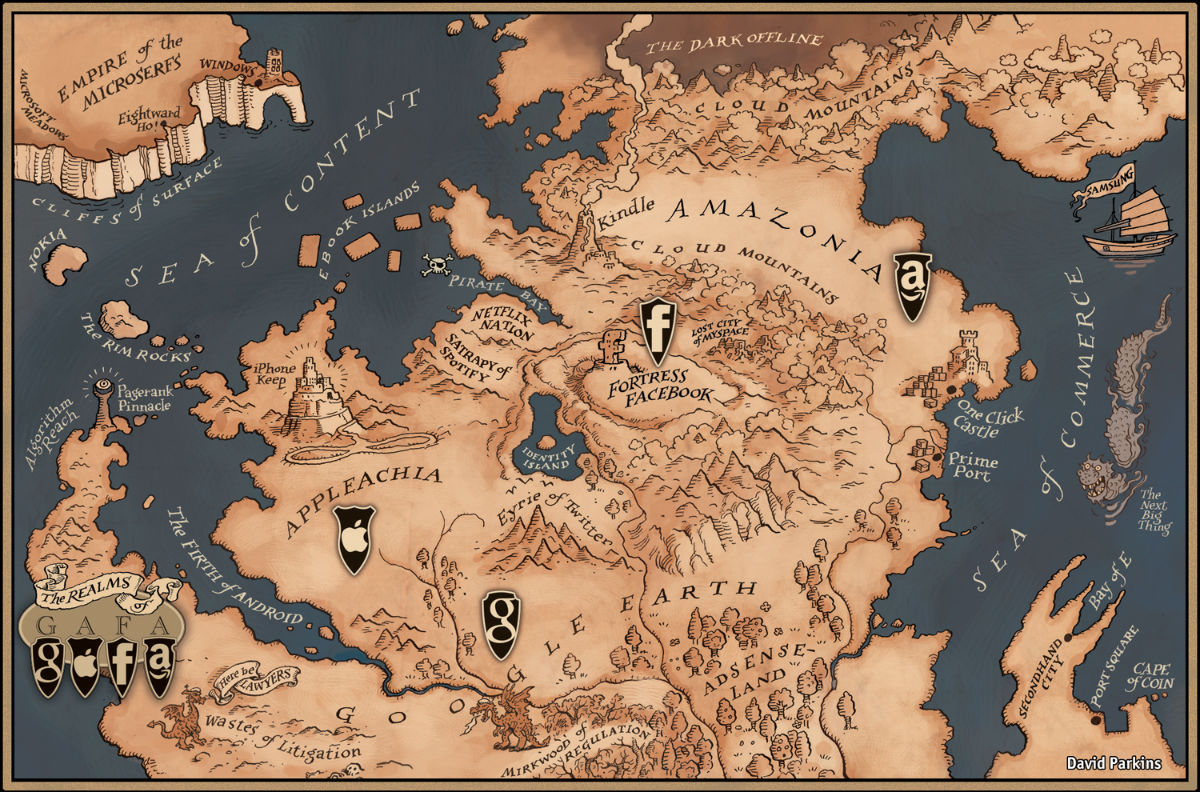
科技时代下的冰火大陆
冰与火之歌吧
全部回复
仅看楼主
level 9
reyalz2004 楼主
话说今天看到一张经济学人的杂志配图,借用了冰火世界的地图来描述科技世界的现状,纷争的4个主角为google,apple,facebook和amazon,当然如果细看的话你还能从图上找到微软,win8,surface,三星,诺基亚,ebay等等。。。懂的自然懂[揉脸]
2012年12月02日 13点12分 1
level 13
脸谱城伯爵,苹果城伯爵,亚马逊亲王以及谷歌铁卫,我命你们攻下渊凯!
2012年12月02日 13点12分 2
疯王微软表示也要分一杯羹
2012年12月03日 06点12分
level 12
这图好欢乐呐!~~[臭美]
2012年12月02日 14点12分 3
确实挺欢乐的,槽点无数
2012年12月03日 06点12分
level 11
- - 前面四个有任何利益纷争?
2012年12月02日 14点12分 5
有,请看楼下附上的原文
2012年12月03日 06点12分
level 12
BAY OF E,神了
2012年12月02日 14点12分 6
我也是觉得ebay亮了[抖胸]
2012年12月03日 06点12分
level 10
是我眼力不好么,这是哪里啊...
2012年12月02日 14点12分 7
level 13
有点像中土大陆的地图
2012年12月02日 17点12分 8
level 11
这个真的是维斯特洛。。。?
微软岛看起来像是乱入的。。。
2012年12月02日 17点12分 9
难道不是都是乱入的吗???[汗]
2012年12月03日 06点12分
level 8
谷歌在君临,苹果在谷地,facebook在恐怖堡,亚马逊在北境
谷歌胯下铁王座是众人争夺焦点,苹果坐拥高端技术有恃无恐坐山观虎,脸谱大概代表驻扎在恐怖堡的西境势力,亚马逊则被边缘化了,正在力求反扑
2012年12月02日 17点12分 10
北境的亚马逊,少狼王[Yeah]
2012年12月03日 06点12分
西境...Facebook应该在凯岩城吧,剥皮家的恐怖堡在北境... —来自UNSC圣彼得堡号重驱逐舰,致远星上空
2012年12月04日 05点12分
回复 最后的装甲兵 :凯岩城肯定不对,应该是赫伦堡,记错了
2012年12月04日 17点12分
level 9
三星和那条水里的龙有点意思,东方龙是明显暗示中国的山寨军团吧~!
2012年12月03日 02点12分 11
高见,据说到2014年天猫有望成为世界最大的网络销售商,还有中国的手机制造商军团,果然最后的胜者还是龙家吗?[顶]
2012年12月03日 06点12分
level 13
我第一反应是佛索威家族突然就牛逼起来了……
2012年12月03日 03点12分 12
戳到笑点。。。
2012年12月03日 04点12分
自从乔布斯帮主一统红苹果和绿苹果后就沿用了黑底白苹果[鲁拉]
2012年12月03日 06点12分
level 11
实在是亮点太多,已经吐槽无力了。做这图的大神儿得多牛掰啊,背后得有多大的分析组啊。
2012年12月03日 05点12分 13
写这文章和画这图的明显都是冰火的铁粉啊
2012年12月03日 06点12分
level 9
reyalz2004 楼主
Search engines and siege engines
It will not be easy to wrest this profitable property from Google. But each of the other web giants would dearly love to carve out a chunk. Arguably the biggest threat comes from Apple. The two firms used to enjoy one of the cosiest relationships in the tech industry—so cosy, in fact, that the search firm’s then chief executive, Eric Schmidt, sat on Apple’s board from 2006 to 2009. Now they are locked in a conflict that is every bit as intense as one of Mr Martin’s, if slightly less well provided with incest, debauchery and parricide. At its heart lies the competition between Apple’s iOS mobile operating system, which powers the iPhone and the iPad tablet computer, and Android, Google’s rival operating system, which is used by a host of manufacturers such as Samsung and HTC. Google snapped up the firm that created Android in 2005 as a strategic hedge; it was worried that its search engine and other services might be excluded from mobile devices owned by potential rivals. It has since turned the system into a formidable competitor to iOS. According to IDC, a market researcher, Android was the system of choice for three-quarters of the 181m smartphones shipped in the third quarter of 2012. Google claims it is activating 1.3m Android devices a day. What Google portrayed as a smart way to keep options open looked to Apple like a declaration of war, one in which a furious Jobs said he intended to go “thermonuclear”. Apple’s Siri voice-activated personal assistant is part of the attack—a new sort of search engine that can serve up answers to people on the go. Apple’s controversial decision earlier this year to take Google Maps out of iOS and replace it with the company’s own, flawed mapping product is another attempt to provide ways of finding things that are Google independent. Some experts think Amazon also poses a threat in this battle to find things. “Google used to be the toll-taker, directing people to Amazon,” says John Battelle, a seasoned Valley-watcher and the founder of Federated Media. “Now people are increasingly bypassing it and going straight to Amazon to find and buy stuff.” He has a point: Forrester, a research firm, reckons that 30% of America’s online shoppers begin their search for a product at Amazon. Facebook is also rumoured to be working on a search product with a social spin. Mr Zuckerberg recently said at a conference that, thanks to folk looking for friends and other things, the social network was handling “on the order of a billion queries a day already, and we’re basically not even trying.” While Apple fights Google on one border, it fights Amazon on another, where the battle is to be the best provider of online content. After it launched the iPod, Apple mounted an unexpected raid into the realm of content with its iTunes digital music store. The content sold the hardware, and vice versa—a successful strategy that started a new rivalry with Amazon, which began as a bookstore in the mid-1990s but soon diversified, first into selling compact discs and DVDs, now into clothes, kitchenware and everything else. But last year 37% of Amazon’s $48 billion revenue still came from media, both physical and digital. The most hard-fought battle between them so far has been in the e-book market. Amazon accounted for some two-thirds of all digital-book downloads in America last year. Apple accounted for just 5%, but it has been trying to woo publishers away from Amazon with an aggressive strategy that gives them more freedom to determine e-book prices than under Amazon’s terms. In digital music, the tables are reversed, with Amazon’s Cloud Player music service struggling to make a dent in iTunes’ huge market share. In video both firms are trying to make headway against Netflix, which has been turning itself from a DVD renter to a video streamer.
2012年12月03日 06点12分 17
level 9
reyalz2004 楼主
Content-maesters
Facebook and Google have so far committed fewer assets to this campaign, though both are aware of its importance. Facebook’s strategy has been to give other firms’ content a social spin. In some territories it has struck alliances with the likes of Netflix and Spotify, a music streaming company, so its users can share what they are listening to or watching on these services with their friends. Google’s YouTube business dominates the world of user-generated video, but the company has struggled to develop a compelling alternative to both Amazon’s digital fare and iTunes. In March it finally brought together its disparate offerings in music, e-books and other areas as part of a new online store, dubbed Google Play, in an effort to concentrate its forces. But Google’s attempts to move into new territories are not always as successful as Android has been. It has mounted various attacks on Facebook’s social stronghold, without notable success.
Among the things Google added to Play were the mobile apps formerly housed in its Android market. The other titans have been hawking their own app selections, too. This is crucial to the way they see their battles unfolding: as a fight between the various platforms with which they seek to provide the best mobile experience. Here there is a three-way fight between Apple, Amazon and Google, which have each developed rival combinations of mobile gadgets, operating systems and app stores. Apple, which first woke up to the power of such platforms when it combined the iPod with iTunes, has the high ground. Its margins on iPhones are so good that Asymco, a market-research firm, reckons the company accounted for 60% of the total profits made by the mobile-phone industry in the third quarter of 2012, even though it accounted for just 16% of phone shipments during that period. But Apple now finds itself competing with rivals that have radically different ways of making money. Amazon is flogging its Kindle e-readers and tablet computers, which use a modified version of Android, at pretty much what it costs to produce and sell them. Where Apple used iTunes to sell iPods, Amazon uses its tablets to sell everything else in the world.

2012年12月03日 06点12分 18
level 9
reyalz2004 楼主
Stark realities
Google’s platform plans are less clearly defined. To begin with it was happy for Android phones and tablets all to be made by others, but in 2011 it decided to splash out $12.5 billion on Motorola Mobility, a handset-maker among other things. Google already markets its Google Nexus tablets, which are made by Asus and Samsung. And it has recently begun selling cheap notebooks using not Android but another of its operating systems, Chrome. Most analysts expect Google to churn out relatively cheap devices in the hope that buyers will use them to access its search and other services, thus seeing the ads on them. And then there is the empire over the water. Microsoft, which in America is now number two in search after Google, has a willing (and desperate) vassal in Nokia, a phonemaker, and a new mobile operating system. Built into its recently launched Surface tablet, this gives it a shiny new platform of its own. Like the Targaryen family, which used to rule Westeros and now plots in exile to regain the crown, the company is desperate to regain its former glory. Facebook has so far stayed neutral in this. But it is not a bystander in the competition to create the best possible digital shopping experience for consumers—another battle for which those platforms are being built. To win this one means taking turf from Amazon. Facebook Gifts is a new service in America which mines what the company knows about its users, their tastes and their friendships to encourage them to buy and send each other gifts at appropriate times, such as birthdays. To get it off the ground Facebook bought a gift-giving outfit called Karma and forged partnerships with over 100 companies, including Starbucks and Lindt, a chocolatier. Google is experimenting with a service that would let folk find goods online, order them and have them delivered within a day for a modest fee. This seems similar to Amazon’s hugely successful “Prime” service, which costs $79 a year to join in America. Rather than try to replicate the e-commerce giant’s extensive network of warehouses, Google is looking for partnerships with shipping companies and retailers instead. But if it is serious about taking on Amazon, it may ultimately have to buy a logistics firm. At $69 billion UPS has a market value less than a third of Google’s; it is valued at less than twice the search giant’s cash pile. Platforms are the weapons with which the warring factions seek to rule their own lands and conquer new ones. Patents are the weapons with which they try straightforwardly to hurt their rivals. Although some lawsuits have been launched by “trolls” who accumulate patents without actually making stuff, a number have been launched by one giant, or a company acting as its catspaw, against one of the others. Apple has been lobbing lawsuits around in the smartphone arena as if armed with a trebuchet. Google snapped up Motorola Mobility in large part to get its hands on the firm’s thousands of patents issued and pending, thus bulking up its own defences and accumulating ammunition to fling at the fortresses of the competition. With the battlefields seeming to multiply every quarter—mobile wallets, cloud computing and who knows what else—picking out the strategic shifts over the tactical setbacks is hard. Today’s apparent failures may contain the seeds of future victories. Google+, Google’s latest attempt to lay siege to Facebook, has its flaws. Apple was woefully under-prepared for its assault on Google Maps. But if Google wants to progress in the social arena, and Apple in location-based services, they have to make bold bets, and in both cases they have at least gained some sort of beachhead. The challenge the firms face is to move beyond the initial disappointment cannily enough to turn the openings into successes. No one looks likely to win quickly. “There will be a lot of trench warfare,” predicts Roelof Botha of Sequoia Capital, a venture investor. And that looks likely to be great news for consumers, who will be able to choose from an ever wider range of innovative and cheap (or free) technologies. Of course, as competition increases, firms might be tempted to lock down their heartlands more tightly—or to use foul means to attack those of others. This is bringing regulators out of their lairs. “You’re starting to see an empire-strikes-back moment amongst antitrust authorities,” says Adam Thierer, a researcher at George Mason University.
2012年12月03日 06点12分 19
level 9
reyalz2004 楼主
The Others
Watchdogs in Europe and America have been looking into accusations that Apple has colluded with some publishers to break Amazon’s grip on e-books. And they have been scrutinising Google too. Some companies, including ones with links to Microsoft, have accused the search firm of unfairly promoting its own services, such as Google+, in search results. They also claim that it uses content from competitors without permission, and that it has struck anti-competitive deals in search advertising. The firm is under fire for allegedly using smartphone patents to stifle competition. Google’s legions of lawyers have been battling these charges. Their lordships Page, Cook, Zuckerberg and Bezos thus need to map a course for their respective firms through dangerous legal and regulatory territory. At the same time they have to avoid being distracted from fighting their rivals; the mad emperors of Microsoft lost a lot of ground by taking on the inhuman might of the Department of Justice. And the shareholders, hungry for returns in a moribund global economy, need to be kept happy. A king who pulled all this off might claim the throne by right; but his chances of being more than first among equals, or of a lengthy reign, would be slim. As in Westeros, these battles and plots promise many more sequels and series.
2012年12月03日 06点12分 20
这铁王座。。。一眼看上去还以为是电刑椅
2012年12月03日 08点12分
真巧,今天刚看到这篇,欢乐了很久~
2012年12月03日 10点12分
回复 24格包 :[大笑]+1~~~~~~
2012年12月03日 14点12分
level 2
马克了!!!!!顺便学习英语~~~~
2012年12月03日 07点12分 21
level 13
微软果然是龙家啊[哭着跑]
2012年12月03日 07点12分 22
1 2 尾页