
level 11
本子2010
楼主
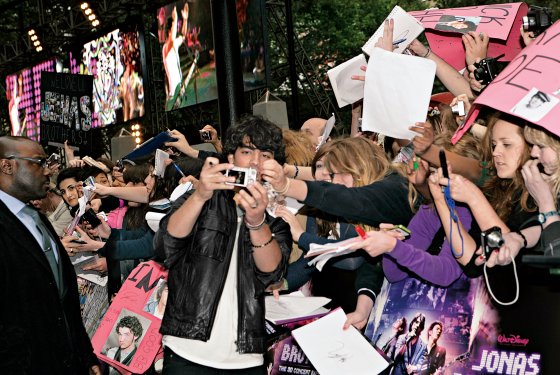
Joe Jonas: My Life As a Jonas Brother
 As told to Jennifer Vineyard.
To some extent, I was used to growing up in public. I was a pastor’s kid, so eyes were always on me, even then. I sat in the first pew of the church, and I had to wear a suit every Sunday, because my parents wanted me to be this role model that I didn’t always want to be. I preferred going to punk-rock shows in small venues in New Jersey, where we grew up, wearing my jean jacket and all my band pins. That’s how I fell in love with music, how I became obsessed with it. I’d stand there, watching the singer running around the stage, owning the crowd. I didn’t even notice whatever else was happening onstage. All I could see was the singer.
But I had certain obligations at that age. If I ever didn’t want to go to church on Sunday, or when I was trying to figure out what religion I wanted to be, or trying to understand spirituality, I would always have to deal with knowing that people were looking up to me. We eventually left our church, Assembly of God, when I was 14. A scandal had erupted involving stolen money, and it caused a big rift in the church. After that the concept of church really upset me for a long time. I mean, I believe in God, and that’s a personal relationship that I have, but I’m not religious in any way.Being a part of a company like that comes with certain expectations. Not overtly, but there was a subtle vibe. We were working with Disney in 2007 when the Vanessa Hudgens nude-photo scandal happened. We heard that she had to be in the Disney offices for a whole day because they were trying to figure out how to keep her on lockdown. We’d hear execs talking about it, and they would tell us that they were so proud of us for not making the same mistakes, which made us feel like we couldn’t ever mess up. We didn’t want to disappoint anyone—our parents, our fans, our employers—so we put incredible pressure on ourselves, the kind of pressure that no teenager should be under.
We were just kids. That’s the reality. We were frightened little kids. So you got all this responsibility that’s foisted upon you and you’re expected to be perfect. I went through media training, and I hated it. They’d teach you how to change the subject, whenever you were asked an uncomfortable question, by saying something like, “Oh, that reminds me of my dog! I have a great story about my dog!” Playing dumb is the best way of getting out of anything. We also had a strategy for who would take which kinds of questions. If it was a serious question, Nick would answer it. If it was lighthearted, Kevin would. Nick and I took questions related to our music and explaining what certain songs meant. We even did a Good Housekeeping story with our mom where we were wearing these horrible pastels. It makes me cringe just to think about it.
2013年12月02日 12点12分
1
As told to Jennifer Vineyard.To some extent, I was used to growing up in public. I was a pastor’s kid, so eyes were always on me, even then. I sat in the first pew of the church, and I had to wear a suit every Sunday, because my parents wanted me to be this role model that I didn’t always want to be. I preferred going to punk-rock shows in small venues in New Jersey, where we grew up, wearing my jean jacket and all my band pins. That’s how I fell in love with music, how I became obsessed with it. I’d stand there, watching the singer running around the stage, owning the crowd. I didn’t even notice whatever else was happening onstage. All I could see was the singer.
But I had certain obligations at that age. If I ever didn’t want to go to church on Sunday, or when I was trying to figure out what religion I wanted to be, or trying to understand spirituality, I would always have to deal with knowing that people were looking up to me. We eventually left our church, Assembly of God, when I was 14. A scandal had erupted involving stolen money, and it caused a big rift in the church. After that the concept of church really upset me for a long time. I mean, I believe in God, and that’s a personal relationship that I have, but I’m not religious in any way.Being a part of a company like that comes with certain expectations. Not overtly, but there was a subtle vibe. We were working with Disney in 2007 when the Vanessa Hudgens nude-photo scandal happened. We heard that she had to be in the Disney offices for a whole day because they were trying to figure out how to keep her on lockdown. We’d hear execs talking about it, and they would tell us that they were so proud of us for not making the same mistakes, which made us feel like we couldn’t ever mess up. We didn’t want to disappoint anyone—our parents, our fans, our employers—so we put incredible pressure on ourselves, the kind of pressure that no teenager should be under.
We were just kids. That’s the reality. We were frightened little kids. So you got all this responsibility that’s foisted upon you and you’re expected to be perfect. I went through media training, and I hated it. They’d teach you how to change the subject, whenever you were asked an uncomfortable question, by saying something like, “Oh, that reminds me of my dog! I have a great story about my dog!” Playing dumb is the best way of getting out of anything. We also had a strategy for who would take which kinds of questions. If it was a serious question, Nick would answer it. If it was lighthearted, Kevin would. Nick and I took questions related to our music and explaining what certain songs meant. We even did a Good Housekeeping story with our mom where we were wearing these horrible pastels. It makes me cringe just to think about it.


 ,我还不知道,

